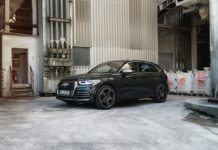
Audi presented officially the new R8, which will debut at the Geneva Motor show next week. The car features a honeycomb grille, large air intakes, angular design Matrix LED lights, with variable intensity, carbon side air intakes in the front of the rear wheels and inflated fenders.

The car also features a rear spoiler (active in the simple version and stable at the Plus), diffuser and quad exhaust tailpipes.The interior features a double central air intake, three-spoke steering wheel with aluminum bottom parts, Head-Up Display, digital instrument panel of 12.3 inches, as the one in the new TT, digital central mirror, multifunction steering wheel with paddles and new MMI infotainment system, integrated into the dashboard. There are also new bucket seats covered with Nappa and audio Bang & Olufsen 500 watt system.
The new R8 has a length of 4.42 meters width of 1.94 meters, height of 1.24 meters, a wheelbase of 2.65 meters and it weighs 1,454 kilos, 50 fewer than the previous generation. It stands on 19 inch wheels with tires sized 245/35 front and 295/30 rear.
It is equipped with a 5,2 liter V10 engine in the simple version delivering 540 hp at 8,000 rpm with 540 Nm of torque at 6,500 rpm, while the Plus version delivers 610 hp at 8,150 rpm with 560 Nm of torque at 6,500 rpm. The engine is combined with a new 7-speed automatic transmission that offers faster and smoother changes, having three operating modes and a Start/Stop system. The power is transferred to all wheels through a electro-hydraulic multi-plate clutch that can carry 100% of torque from the front axle to the rear and vice versa.

The Audi R8 V10 Plus does the 0-100 km/h in 3.2 seconds, with a top speed of 330 km/h, while the R8 V10 does the 0-100 km/h in 3.5 seconds, with a top speed of 323 km/hour. The R8 V10 has an average consumption of 11.8 liters/100 km with 275 g/km emissions of CO2, while the V10 Plus consumes 12.4 liters/100 km and emits 289 g/km of CO2.
The new R8 has a carbon-aluminum monocoque chassis, (23% of carbon and 77% aluminum) which weighs 198 kilos. The body and the anti-roll bars are made of CFRP, while it uses the “same general layout” as the Lamborghini Huracan and although the new R8 is built on the new MSS (Modular Sports Car System) platform of the VW Group, the same as the Lamborghini Huracan, it has its own driving behavior in relation to Huracan.
Audi will also present in Geneva the R8 e-tron, which is equipped with two electric engines producing a total of 340 kW (462 hp) with 920 Nm of torque, with the 0-100 km/h to be completed in 3.9 seconds, having autonomy of 450 km and a top speed of 250 km/h.
The R8 e-tron will be equipped with a wireless charging system, with Audi to prepare the plug-in hybrid version, which will use the hybrid set of the Lamborghini Asterion concept, but also a version with a diesel engine.

Audi has announced that the racing R8 LMS, is 50% identical to the production model and it will be unveiled sometime this year. It will race in the GT3 races in 2016 and it will weigh 1,255 kilos, equipped with a V10 engine producing 585 hp, with the power to be passed to the rear wheels.
Sales of the new R8 will begin in the summer and in Germany the R8 V10 starts at €165,000 and the R8 V10 Plus at €187.400.